
Samsung Electronics shares fell 7.39% on October 13. SK hynix shares fell 10.09%. Both companies make memory chips, and the selloff in their stocks got worse that day. A selloff is a stretch of heavy selling that drives prices down. Korea's stock exchange paused computer-driven sell orders for five minutes that morning.
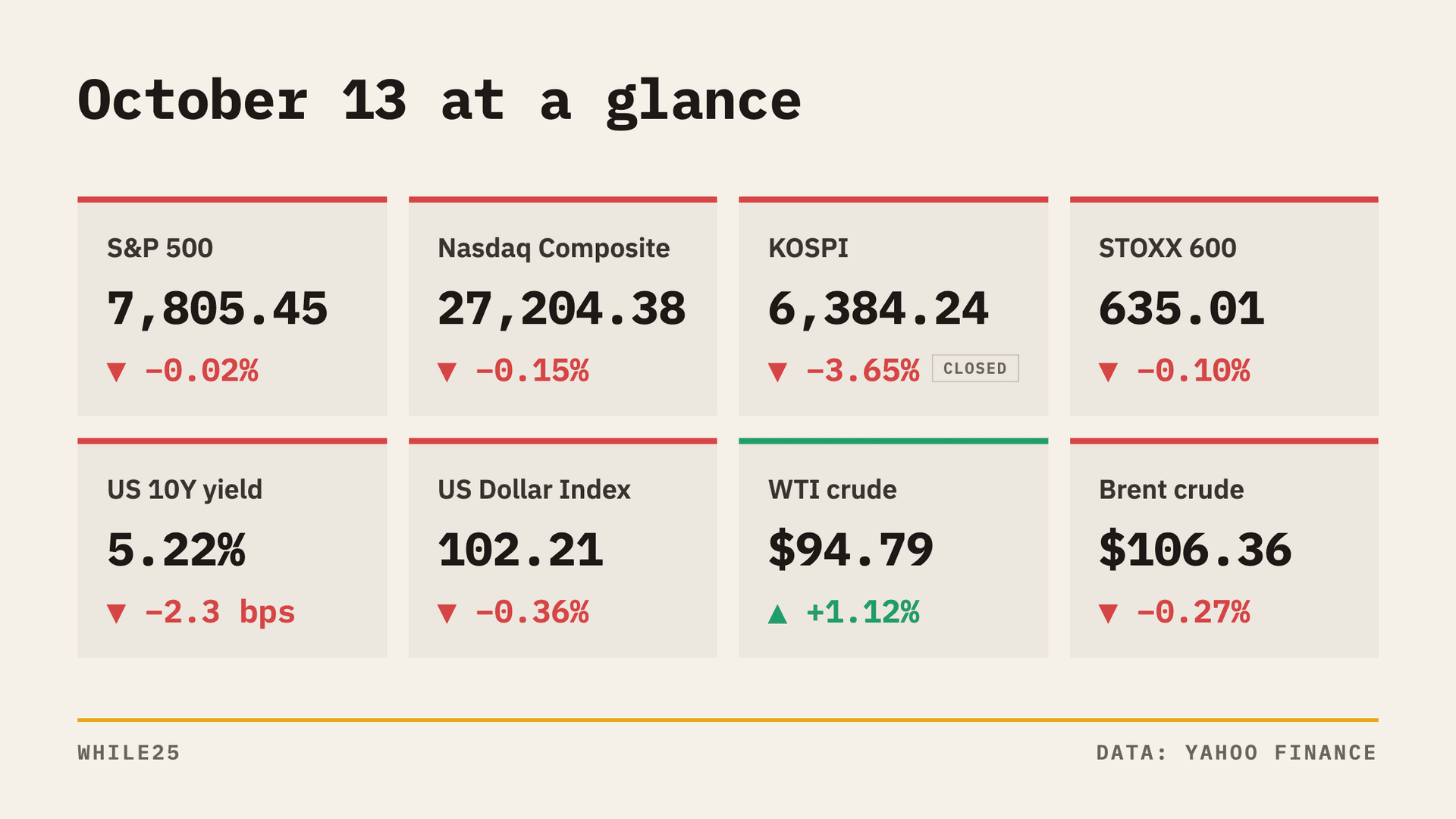
In New York, the S&P 500 ended at 7,805.45, down 0.02%. The S&P 500 is an index that tracks 500 large US companies. Investors there reacted to bank earnings and a drop in Johnson & Johnson. Earnings are the profits a company reports each quarter. Near the close, investors reacted to comments from a Federal Reserve official. The Federal Reserve, or Fed, is the US central bank. Investors pushed the index up and down as the news came in.
Seoul's chip selloff deepened
Selling in Seoul began before October 13. On October 12, the KOSPI fell 3.65% to 6,384.24. The KOSPI is Korea's main stock index. That drop was its fourth in a row. Foreign investors sold a net 2.0194 trillion won of Korean stocks that day. "Net" means their sales minus their purchases. They had sold more than they bought for five straight sessions. A session is one trading day. Samsung fell 4.39% that day, and SK hynix fell 4.52%.
Foreign investors sold harder on October 13. They sold a net 2.2 trillion won more. The KOSPI opened 3.1% lower. By 9:50 a.m. in Seoul, it was down 4.03% at 6,127.15.
At 9:48 a.m., the Korea Exchange halted program trading for five minutes. Program trading means large baskets of orders that computers place. The exchange calls this pause a sidecar. It triggers a sidecar when KOSPI 200 futures fall 5% or more for at least one minute. The KOSPI 200 is an index of 200 large Korean stocks. Futures are contracts to buy or sell the index at a set price on a later date. This sidecar was the first in close to two months.
Samsung's share price closed at 232,000 won. SK hynix closed at 1.443 million won.
 KOSPI index level over the five sessions through October 12, showing a steady slide
Analysts pointed to a Chinese rival
Analysts pointed to CXMT, China's largest maker of DRAM. DRAM is the working memory inside computers and data-center servers. CXMT President Cao Kanyu reported "key progress" on server memory. CXMT built that memory with a denser design for its memory cells, the tiny parts that store data. The company plans to launch DDR5 memory modules for servers by year-end. DDR5 is the current standard for fast server memory. Samsung and SK hynix sell into that market.
Another source of demand for the two stocks is fading. A buyback is a company purchasing its own stock. Buybacks add steady demand for the shares. Samsung has finished buying back shares to pay its employees in stock. SK hynix is close to completing its buyback program. With the buybacks ending, foreign sellers met fewer large buyers.
An analyst at Eugene Investment & Securities studied the outflows, the money foreign investors pulled out. The analyst said the outflows were too large to explain as routine rebalancing after a rally. A rally is a run of rising prices. Rebalancing means selling some winners to bring a portfolio back to its target mix. Foreign investors have sold a net 199 trillion won of Korean stocks so far this year.
The worry crossed to New York
Micron fell 3.62% after reports of a DRAM design breakthrough in China. Micron is a US maker of memory chips. Sandisk fell 0.34%. Investrade said tech stocks lagged, meaning they did worse than the broader market. It named chip stocks and memory names like Micron, Sandisk and Western Digital as weak. The Nasdaq Composite, an index heavy in tech companies, fell 0.15%.
Mixed news from banks and a drugmaker
Banks opened third-quarter earnings season with mixed results. Earnings season is the stretch of weeks when companies report quarterly results. JPMorgan earned $5.57 a share, below the $5.93 analysts expected. Earnings per share is a company's profit divided by its number of shares. JPMorgan's profit rose from $5.07 a share a year earlier.
The bank raised its 2026 forecast for net interest income to $106.2 billion from $105.5 billion. Net interest income is what a bank earns on loans minus what it pays on deposits. JPMorgan shares recovered from an early 3% drop, according to Investrade.
 JPMorgan third-quarter earnings per share versus the analyst estimate and the year-earlier quarter
Goldman Sachs earned $17.01 a share, up from $12.25 a year earlier. Its revenue from trading stocks for clients rose 72% to $6.44 billion. Revenue is the money a company brings in before costs. Wells Fargo earned $1.87 a share, above the $1.84 consensus. The consensus is the average forecast from analysts. Wells Fargo's revenue of $21.87 billion missed the $22.31 billion estimate. Its shares fell 1.5%.
Johnson & Johnson shares fell about 6%. Sales at its medical-device unit, MedTech, rose 2.5% to about $8.6 billion. Analysts had expected $8.71 billion, according to LSEG, a financial data firm. MedTech has now missed forecasts for two straight quarters. Blackstone, an investment firm, fell 4.18%.
Energy stocks rose and made up for part of the losses in chips and healthcare.
A late bounce after Williams spoke
Investors bought stocks near the close after an interview with John Williams. Williams is president of the New York Fed, one of the Fed's regional banks. He told Bloomberg News that one more rate hike this year may be appropriate. A rate hike is an increase in the Fed's main interest rate. He added that, at this point, he had no reason to believe the Fed would need to do more in 2027.
The Fed's policy rate is its main tool for setting borrowing costs. The Fed raised it a quarter of a percentage point in September. The rate now sits in a 3.75% to 4.00% range.
Futures traders expect a different path. CME FedWatch is a tool that turns prices of futures tied to the Fed's rate into odds of future moves. It showed about 90% odds that the rate ends 2027 at least half a percentage point higher.
The S&P 500 finished down 1.79 points. The Dow Jones Industrial Average, an index of large US companies, fell 0.35%, or 180.45 points. The Russell 2000, an index of smaller US companies, fell 0.40%. The VIX ended at 15.27. The VIX is a gauge of how much traders expect stocks to swing.
Europe and the rest of Asia
European stocks ended close to flat. The STOXX 600, an index of large European companies, fell 0.10%. Germany's DAX and France's CAC 40 each fell 0.07%. Those are the main stock indexes in each country. The UK's FTSE 100 fell 0.06%.
The latest Asian closes in our data are from October 12. Hong Kong's Hang Seng rose 0.25%. Shanghai fell 0.43%, and India's Nifty 50 fell 0.70%. Japan's Nikkei 225 last closed on October 9. Korea's KOSPI fell 8.42% over five sessions, the deepest drop in the region.
 Day change for major stock indexes in the US, Europe and Asia, with Korea's KOSPI the largest decline
Bonds, the dollar, oil and gold
The 10-year Treasury yield fell 2.3 basis points to 5.217%. A Treasury is a bond, or loan, that the US government sells to investors. The 10-year yield is the interest rate the government pays to borrow for 10 years. One hundred basis points make one percentage point.
The US Dollar Index fell 0.36% to 102.208. The index tracks the dollar against a basket of major currencies. The euro rose 0.39% to $1.1203.
The two main oil prices moved in opposite directions. US crude, known as WTI, rose 1.12% to $94.79 a barrel. Brent, the global benchmark price for oil, fell 0.27% to $106.36. Brent fell after President Trump said Russia had agreed to supply diesel to world markets. The US lifted sanctions on Russian fuel for a limited period. Sanctions are penalties that block trade.
US diesel futures rose 2.1% to $4.82 a gallon. Refiners, the companies that turn crude oil into fuels, gained from wide fuel margins. A fuel margin is the gap between the price of crude and the price of fuel.
OPEC has cut its forecast for 2026 global oil demand growth to 400,000 barrels a day. OPEC is a group of major oil-producing countries. At the start of the year, it had forecast 1.4 million barrels a day.
Gold fell 0.15% to $4,184.20. Bitcoin rose 1.96% to $83,365.91.
Dates ahead
- October 14, 8:30 a.m. ET: The US releases the September consumer price index (CPI). The CPI is the main gauge of inflation, the rise in prices over time. Investrade expects headline inflation of 3.6% from a year earlier, up from 3.4%. Headline inflation covers all items. Investrade expects core inflation at 2.5%, up from 2.4%. Core inflation leaves out food and energy.
- October 14: Morgan Stanley, Bank of America, State Street and BlackRock report third-quarter earnings.
- October 27 and 28: The Federal Reserve holds its policy meeting. It announces its rate decision on October 28.
For your portfolio
Investors in Seoul and New York sold memory stocks on the same day after a Chinese chipmaker's claim. Chip makers in different countries sell into the same server market. A fund pools money from many investors to buy many stocks. A fund spread across many countries can hold the same chip risk in several places.
The S&P 500 ended flat while single stocks moved by several percent. Micron, Johnson & Johnson and Blackstone fell, and energy stocks rose. A flat index can hide large moves inside it.
Williams and futures traders disagree on the path of interest rates. The CPI report on October 14 is the next scheduled test. The Fed decision on October 28 follows.
Sources
- koreajoongangdaily.com
- koreajoongangdaily.com
- en.fnnews.com
- koreaherald.com
- fool.com
- cnbc.com
- fortune.com
- forbes.com
- investing.com
- sec.gov
- cnbc.com
- investrade.com
- finance.yahoo.com
- jingletree.com
- bls.gov
- kiplinger.com
- investinglive.com
- hdfcsky.com
Not investment advice.