
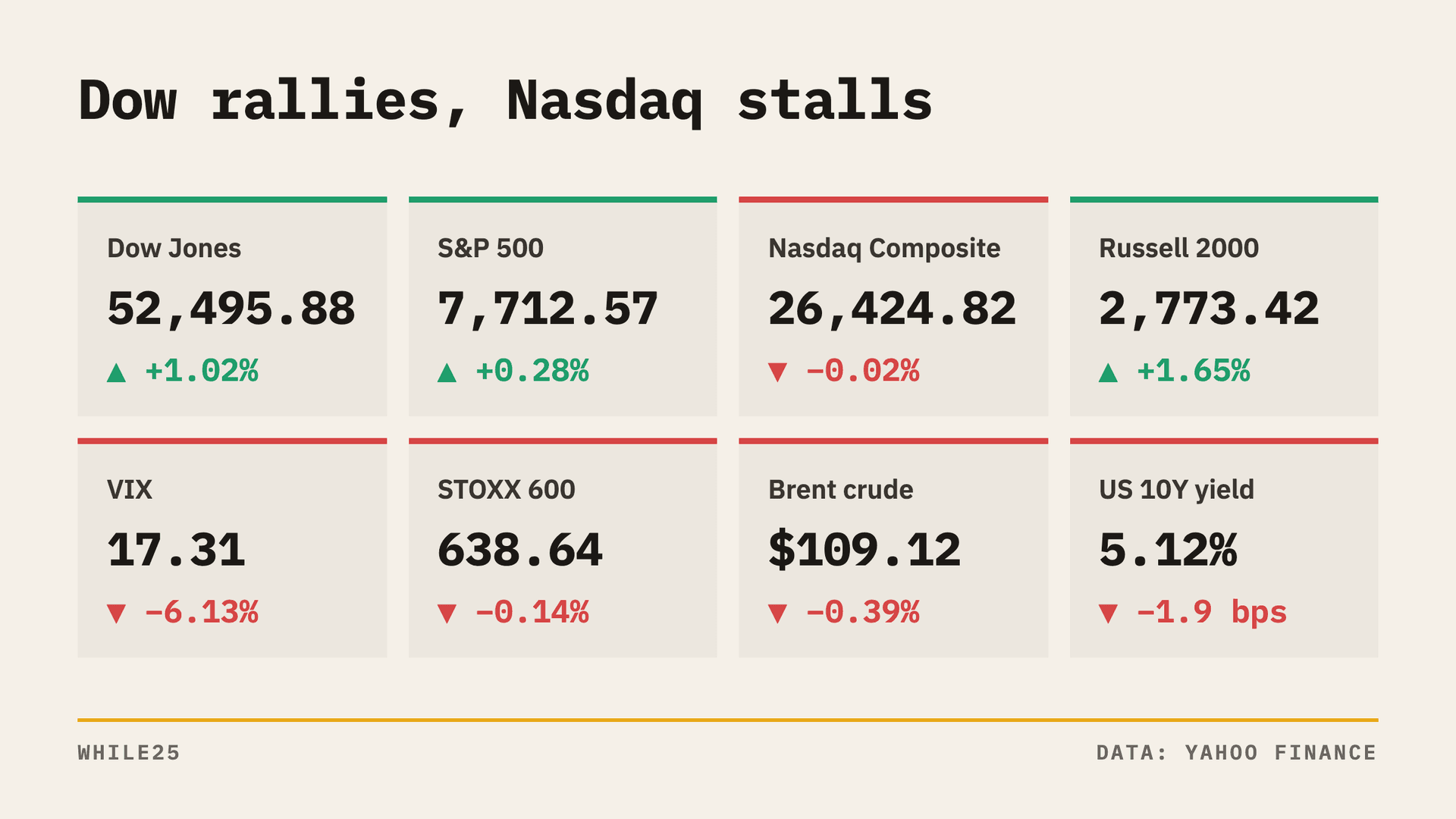
The Dow Jones Industrial Average rose 529.85 points, or 1.02%, to 52,495.88 on October 20. The Dow is a stock index, a single number that tracks the prices of a group of stocks. Its group mixes industrial and consumer companies. A point is one unit of the index's value. The Nasdaq Composite is an index tilted toward technology companies. It ended flat, almost unchanged.
Investors bought shares of older industrial and consumer companies that reported strong profits. A share is a small slice of ownership in a company. The S&P 500, which tracks 500 large US companies, added 0.28% to 7,712.57. The Nasdaq slipped 0.02% to 26,424.82.
The two indexes moved apart because investors favored some kinds of companies over others. Factory, credit and toy companies posted profits above forecasts. Buyers rewarded them with higher share prices. Investors kept away from AI stocks. Shares of a South Korean AI company had sunk on their first day of trading in Seoul.
Shares of smaller companies gained the most. The Russell 2000, an index of smaller US companies, gained 1.65% to 2,773.42. The VIX measures how much traders expect stocks to swing in the coming weeks. It fell 6.13% to 17.31. A lower VIX means traders are paying less to protect themselves against big price moves.
 Day change for major US and European stock indexes on October 20, with the Russell 2000 and Dow leading and Paris lagging
Investors rewarded strong profits outside tech
3M led the gains. The company makes tape, filters and industrial materials. It earned $2.50 a share on an adjusted basis. Earnings per share is a company's profit divided by the number of its shares. Adjusted means the company strips out one-time items.
Analysts are experts who study companies and predict their results. The data firm LSEG surveyed analysts, who expected $2.38. Sales came to about $6.6 billion. Adjusted earnings per share rose 12% from a year earlier. 3M raised its forecast for full-year profit to $9.10 to $9.15 a share. Its stock rose more than 5%.
 3M's adjusted third-quarter earnings per share of $2.50 against the $2.38 analyst estimate
Shares of Equifax, the credit-reporting company, rose 10.6% by early afternoon. Equifax reported a bigger profit than expected despite high mortgage rates. Mortgage rates are the interest people pay on home loans. Hasbro shares rose 9.3% over the same stretch. Sales of its Magic: The Gathering card game topped $600 million in a quarter for the first time. A quarter is a three-month period.
General Motors shares fell 8.2%, even though its quarterly profit topped estimates. GM narrowed its full-year forecast to $12.75 to $13.75 a share in adjusted earnings. The middle of that range, $13.25, sits below the $13.42 analysts expected.
GM approved a new buyback of up to $20 billion. In a buyback, a company purchases its own shares. That leaves fewer shares in other hands. Investors sold GM stock despite the buyback.
Netflix reported results after the market closed. It earned $0.87 a share, above the $0.82 the company had forecast. Its revenue, the money it took in from sales, came to $12.87 billion. Netflix shares closed the regular trading day at $68.69. In trading after the market closed, they stood 4.0% lower.
Investors gave each company's forecast for the year ahead as much weight as its results for the past quarter. 3M raised its forecast, and its shares climbed. GM's forecast fell short of analysts' expectations. Its shares dropped.
Investors kept away from AI stocks
The Nasdaq's trouble began in Seoul. Shares of Elice, a South Korean AI company, fell 32% on its first day of trading. Elice had sold shares to the public for the first time, a step called an initial public offering. According to Dealogic data, it had South Korea's worst debut among companies that raised more than $100 million this way. A debut is a stock's first day of trading. South Korea's KOSPI stock index fell 3.7% on the day.
Investors grew more worried about AI spending after the debut. AI spending is the money companies spend on AI. Investors had been selling US stocks over those worries before the debut. Last week was the worst for the US stock market since June. Shares of AI-related companies led the losses. The Nasdaq has lost 2.87% over the past five trading days and 2.57% over the past month.
Traders went back and forth on CoreWeave, which rents out computing power for AI work. Its shares fell more than 6% early in trading on October 20. They swung to a 5% gain. Later in the day they stood 2.3% higher. The stock had dropped about 25% the week before.
 Nasdaq Composite over the past month, drifting lower as AI stocks weakened
Salesforce agreed to buy Braze, a maker of marketing software, for $47.50 a share in cash. The deal is worth about $5.66 billion. Braze shares jumped 51.5% to $45.51 by early afternoon. Salesforce shares fell 1.4%.
Oil prices fell back from their high
Brent crude is the price traders use as the global reference for oil. It touched $111.99 a barrel during the trading day. That came close to its highest level since the Iran war began in late February. Traders pushed Brent back down later in the day.
Futures are contracts to buy oil at a set price on a later date. Brent futures for December settled at $108.79, down 0.7%. The settlement price is the official closing price. Our data feed's last reading was $109.12, down 0.39%.
Traders pushed prices down for two reasons. First, they hoped for diplomatic progress between the US and Iran. Traders kept that hope even though attacks on tankers and strikes against Saudi Arabia have escalated. The second reason was an executive order from President Donald Trump. In that order, Trump waived some sanctions and tariffs tied to Russian energy exports. Sanctions are government penalties that limit trade. Tariffs are taxes on imported goods.
This month, traders have bought and sold Brent at prices between $97 and $112 a barrel. That is a wide range for a single month.
Bonds, the dollar and the Fed
Treasuries are the bonds the US government sells to borrow money. A bond is a loan that investors make to a borrower. The 10-year Treasury yield is the interest rate the government pays to borrow for 10 years. It fell 1.9 basis points to 5.117%. One hundred basis points make one percentage point.
Bond prices move opposite to yields. The lower yield means Treasury prices rose. Over the past five trading days, the yield fell 10 basis points.
The Federal Reserve, the US central bank, meets on October 27 to 28. Futures traders put the chance of a rate hike at that meeting at about 17%. A hike would raise the Fed's benchmark borrowing rate. That rate feeds into the cost of loans and mortgages. The meeting ends six days before the November 3 midterm elections.
The US Dollar Index measures the dollar against a basket, or group, of major currencies. It fell 0.27% to 101.704. The euro rose 0.21% to $1.124. The dollar slipped 0.24% against the Japanese yen to 158.14. Gold fell 0.42% to $4,142.5 an ounce. Bitcoin, a digital currency, rose 1.19% to $82,830.89.
Europe and Asia
European stocks edged lower. The STOXX 600, which covers large companies across Europe, slipped 0.14%. France's CAC 40 index fell 0.38%.
Rioters in France have damaged at least 3,000 shops, twice the count from a day earlier. European indexes posted steep losses on October 19 during the protests. London's FTSE 100 index lost 0.29%. Germany's DAX index was little changed, down 0.06%.
In Asia, the main move came from Seoul. There, the KOSPI fell 3.7% after the Elice debut. Our closing data for Tokyo and Shanghai run to October 19. For Hong Kong, they run to October 16. We left their October 20 moves out of this round-up.
Dates to watch
- October 21: Meta reports third-quarter results after the market closes. It holds a call at 4:30 p.m. ET.
- October 21: Tesla posts third-quarter results and holds a webcast at 5:30 p.m. ET.
- October 22: The US government releases weekly initial jobless claims at 8:30 a.m. ET. This figure is the count of new unemployment filings.
- October 23: S&P Global publishes its flash PMIs at 9:45 a.m. ET. PMI stands for purchasing managers' index. These surveys ask the managers who buy supplies for companies about business conditions. "Flash" means an early reading, so the surveys give a first look at business activity. The University of Michigan publishes its final consumer sentiment reading the same day. That survey tracks how consumers feel about the economy.
- October 27 to 28: The Fed meets. It announces its decision on October 28.
- November 3: US midterm elections, held midway through a president's term.
The split and your portfolio
Investors' results on October 20 depended on which index they held. The Dow, with its mix of industrial and consumer companies, gained 1.02%. The tech-heavy Nasdaq ended flat.
An index fund buys the stocks in a single index. Two investors who both "own the market" through different index funds had different days. Meta and Tesla, two of the largest tech companies, report on October 21. The Fed decides on rates one week later.
Sources
- cnbc.com
- finwire.io
- idahostatejournal.com
- finance.yahoo.com
- cnbc.com
- business-standard.com
- koreatimes.co.kr
- euronews.com
- stocktitan.net
- salesforce.com
- mitrade.com
- sec.gov
- investor.atmeta.com
- investing.com
Not investment advice.