
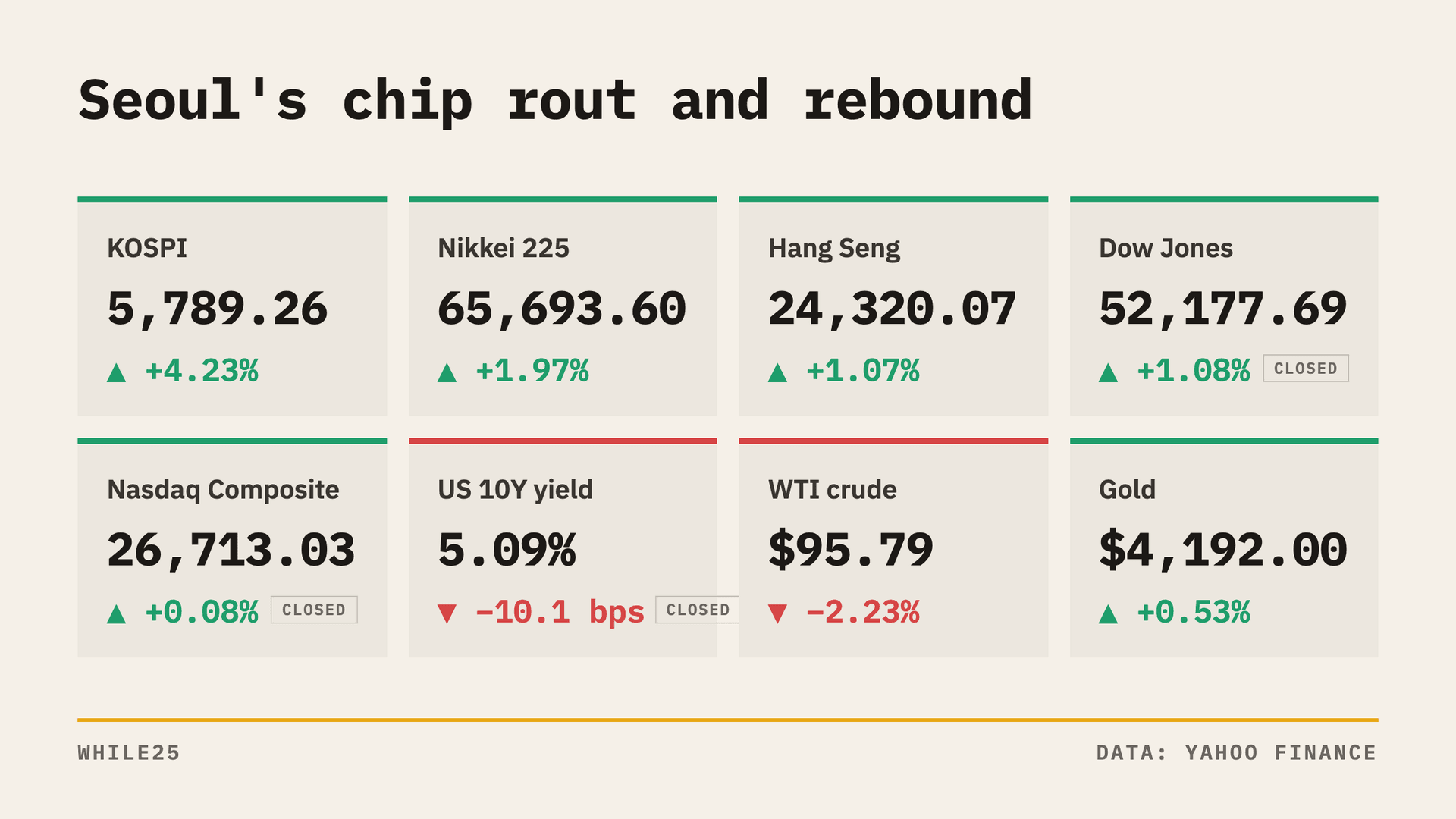
South Korea's main stock index, the KOSPI, fell 7.57% on October 15. Investors sold shares of chipmakers, the companies that make computer chips. They moved much of that money into US government bonds, known as Treasuries. They also bought shares of companies outside the technology sector. On October 16, buyers returned to Seoul, and the KOSPI rose 4.23% to 5,789.26.
Jakarta went the other way. Indonesian stocks fell more than 11%. MSCI, a company whose stock indexes many funds copy, had proposed demoting the country.
Black Thursday in Seoul
The KOSPI closed at 5,554.22 on October 15. It was the index's seventh losing day in a row. It was also its lowest close since April 7. The country's two biggest chipmakers led the fall. Samsung Electronics dropped 9.5%, and SK Hynix lost 11.1%.
The selling started in New York. The night before, the Philadelphia Semiconductor Index dropped 4.3%. That index tracks chip companies listed in the US.
At its worst point, the KOSPI was down 9.29%. The exchange halted trading for 20 minutes. It used a circuit breaker, an automatic rule that stops trading so people can pause. This was the 10th circuit breaker this year and the 16th in the market's history.
Foreign investors sold 3.6 trillion won ($2.68 billion) more Korean shares than they bought. Korea's financial authorities held an emergency meeting. They promised a proactive response.
Analysts tied the selling to two worries. The first is US inflation, the rise in prices, which has stayed high. The second is doubt about the boom in AI investment. Seo Sang-young of Mirae Asset Securities said investors are reacting to "whether capital raising will be sustainable" in AI. Capital raising means companies collecting money from investors and lenders.
Mixo Das of J.P. Morgan said sellers are struggling to find new buyers. He noted that Samsung and SK Hynix have ended their share buyback programs. In a buyback, a company purchases its own shares. That adds steady demand for the stock.
Stocks in Japan and Taiwan fell on the same day. The Nikkei 225, Japan's main stock index, closed 5% lower on October 15. Kioxia and SoftBank Group were among the biggest losers. Taiwan's main index, the Taiex, fell 3%, and TSMC lost 2%.
 Line chart of the KOSPI over the past month, showing a steep slide into mid-October and a rebound on October 16
Bonds gained on a day of bad inflation news
On the same day, the US government reported bad inflation news. The producer price index rose 1.3% in September. This index measures what businesses charge each other. Dow Jones polled economists, who had expected 0.6%. Over 12 months, producer prices rose 6.3%. The monthly jump was the largest since March 2022. Energy prices rose 10.8%.
A bond's yield is the yearly return a buyer earns from it. Fast-rising prices tend to push yields up, because lenders want more interest when prices climb. On October 15, investors bought Treasuries despite the news, and yields fell. Bloomberg reported that Treasuries led a rise in bond prices around the world as selling in AI shares deepened. Investors bought bonds as shelter in case economic growth slows.
The 10-year yield is the interest rate the US government pays to borrow for 10 years. It fell 10.1 basis points to 5.089%. A basis point is one hundredth of a percentage point, so 100 basis points make one percentage point. Over five trading days, the 10-year yield has fallen 14.2 basis points.
Bond prices and yields move in opposite directions. A falling yield means buyers paid more for the bonds.
Some buyers acted out of worry about corporate borrowing. Large companies have sold large amounts of bonds to pay for AI data centers. Selling bonds is a way to borrow money. Investing.com described a "growing crisis of confidence" about that borrowing. Investors paid more to insure high-grade tech debt against default. High-grade debt comes from borrowers judged most likely to repay. Default means a borrower fails to repay.
 Line chart of the US 10-year Treasury yield over five sessions, ending lower at 5.089% on October 15
Yields on European government bonds followed the US lower. The UK 10-year yield fell 4.1 basis points to 5.379%. France's fell 6.7 basis points to 4.794%, and Germany's fell 3.0 basis points to 3.412%.
Investors moved into other stocks
In New York, investors bought shares of companies that depend less on AI. On October 15, the Dow Jones Industrial Average, an index of major US companies, rose 1.08%. The Russell 2000, an index of smaller US companies, gained 1.38%. The S&P 500, the main index of large US companies, added 0.33%. The Nasdaq Composite, an index full of tech companies, rose 0.08%.
The VIX fell 2.43% to 16.46. The VIX measures how much traders expect S&P 500 prices to swing. According to the Associated Press, the S&P 500 had lost 0.9% for the week through October 15. The Nasdaq had lost 2.4% over the same stretch. For the year so far, the S&P 500 has gained 13.1%.
Stocks in Europe followed a similar pattern. Britain's FTSE 100 rose 1.08%, and France's CAC 40 gained 0.78%. The STOXX 600, a broad European index, added 0.38%, and Germany's DAX rose 0.33%. Italy's FTSE MIB fell 0.72%, and Spain's IBEX 35 slipped 0.28%.
Asian buyers returned on October 16
Seoul stocks opened higher on October 16. The KOSPI started the day at 5,653.99. All 20 of its largest stocks were up at the open. It closed up 4.23% at 5,789.26.
The bounce came after a steep October slide. Before October 16, the KOSPI had lost 18.8% this month, according to the Seoul Economic Daily. Japan's market had lost 3.5% and Taiwan's 2.0% over the same period.
Investors value KOSPI companies at about 8 times their earnings, or yearly profits. That means share prices equal about 8 years of current company profits.
Elsewhere in Asia, the Nikkei 225 rose 1.97%, and Hong Kong's Hang Seng gained 1.07%. China's Shanghai Composite added 0.70%, and India's Nifty 50 rose 0.37%.
 Horizontal bars of day changes across Asia, Europe and the US, with the KOSPI rebound leading and the Nasdaq trailing
Jakarta fell on an index proposal
Indonesia faced a separate crisis. On October 15, MSCI proposed moving Indonesia from emerging-market status to standalone-market status. MSCI builds the stock indexes that many funds copy. Emerging-market status puts a country in MSCI's main indexes for developing economies. A standalone market sits outside those indexes. Funds that track MSCI's emerging-market indexes might then have to sell their Indonesian shares.
MSCI pointed to "persistent concerns over transparency, ownership structures and suspected coordinated trading." It said Indonesia's reforms had "not yet delivered sufficient evidence of meaningful improvements in market governance and enforcement." MSCI also runs a frontier-market group for smaller, less developed markets. It said a move to that group "would not properly recognise the depth of the market problems."
On October 16, the Jakarta Composite, Indonesia's main stock index, fell 8% in early trading. The exchange halted trading for 30 minutes. The index ended the day down more than 11%. That was its steepest one-day fall since January 1998. The index has fallen more than 40% since the start of the year.
The rupiah, Indonesia's currency, fell about 0.8% against the dollar to around 18,060 per dollar. A credit rating is a grade for how likely a borrower is to repay its debts. Moody's and Fitch have cut their outlook on Indonesia's rating to negative. A negative outlook warns that a downgrade may follow. Both agencies pointed to the credibility of Indonesia's policymaking.
Oil, the dollar and gold
Oil prices dipped on October 16. WTI, the main price gauge for US crude oil, fell 2.23% to $95.79 a barrel. Brent, the main international price gauge, fell 0.57% to $105.32.
The day before, WTI had climbed. The US government reported that crude stockpiles, the oil held in storage, fell by 8.6 million barrels. That was the largest weekly drop since February. Prices eased after President Trump said he would not use nuclear weapons in Iran.
US Central Command confirmed that an Iranian projectile struck a Singapore-flagged container ship. The ship sank in the Strait of Hormuz. After the sinking, tanker rates hit record highs. Tanker rates are the cost of hiring ships to carry oil.
The US Dollar Index slipped 0.09% to 101.912. It compares the dollar with a basket of major currencies. The euro rose 0.30% to $1.1228. The dollar held at 157.875 yen. Gold rose 0.53% to $4,192 an ounce, and bitcoin gained 0.72% to $82,148.
Dates to watch
- October 20: Netflix reports its third-quarter 2026 results, its sales and profit, at about 1:01 p.m. Pacific Time.
- October 27-28: The Federal Reserve, the US central bank, meets to set interest rates. Investing.com reported that traders in short-term lending markets see an "overwhelming probability" of a hold. A hold means the Fed leaves rates unchanged.
- November 13, 8:30 a.m. ET: The Bureau of Labor Statistics releases the October producer price index.
- April 30, 2027: MSCI stops taking feedback on its Indonesia proposal. MSCI is due to decide by June 30, 2027.
The lesson for your portfolio
Over these two days, selling spread from one market to many. Investors sold chip stocks in New York, then in Seoul, Tokyo and Taipei. Afraid of more losses, they moved money into US Treasuries. They bought enough to push the 10-year yield down on a day of bad inflation news. The 10-year yield feeds into mortgage rates, the interest on home loans. It also affects the prices of bond funds you may own.
The fall in Jakarta points to a second kind of risk. An index provider such as MSCI can force funds to sell a country's shares, whatever those companies earn. If you own an emerging-market fund, an index provider decides which countries go in it. If the provider changes its lists, your fund may sell holdings before any company reports a single result.
Sources
- finance.yahoo.com
- bls.gov
- cnbc.com
- investing.com
- bloomberg.com
- investinglive.com
- kare11.com
- en.sedaily.com
- finance.yahoo.com
- investing.com
- finance.yahoo.com
- fxstreet.com
- s22.q4cdn.com
- federalreserve.gov
Not investment advice.